


Before Fortnite had millions dancing and World of Warcraft built entire digital continents, the first online games had no graphics, no sound, and no mouse. They were built entirely from words on a dark screen, and the blueprint they created is the secret foundation for almost every online world we play in today. This is the history of multiplayer online games, and it starts in a place you would never expect. Have the Best information about casino online zonder cruks.
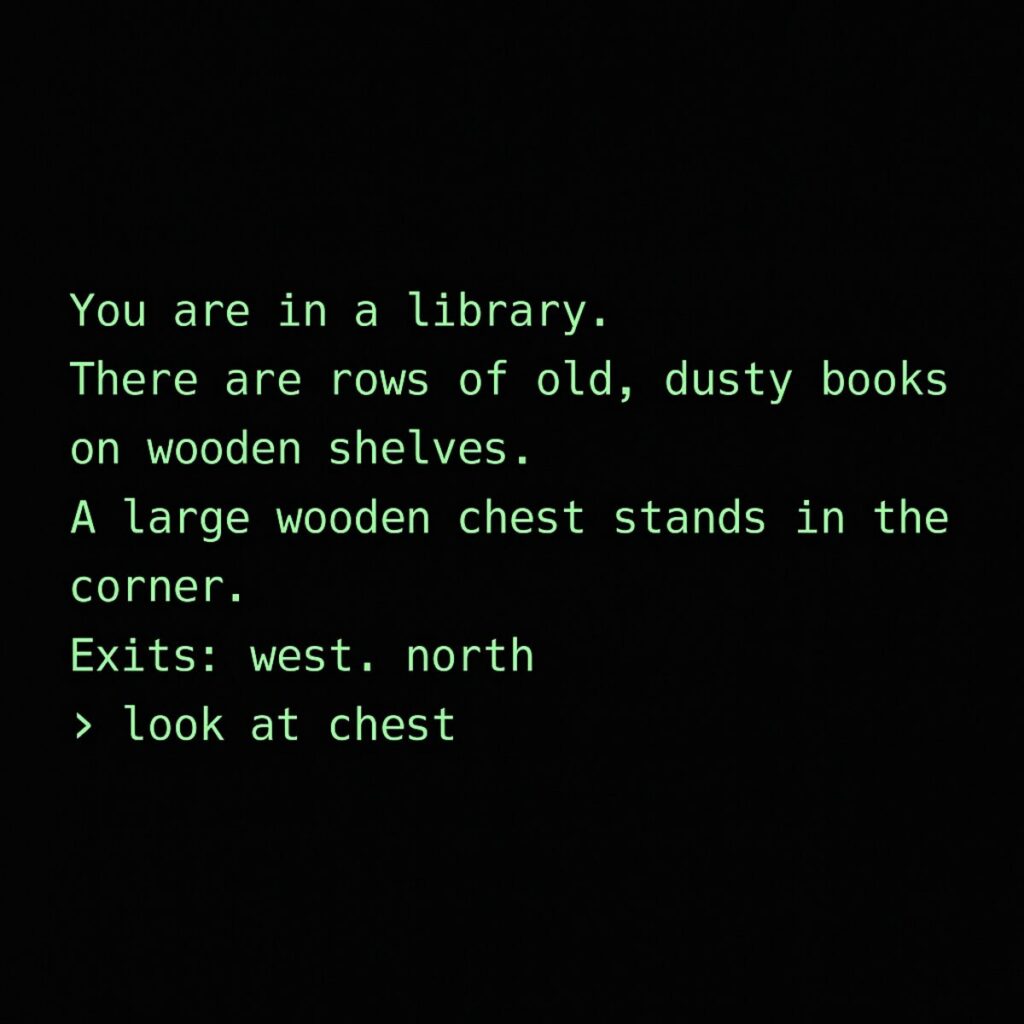
How do you explore a dungeon, fight a dragon, or team up with other adventurers using only a keyboard? Picture a fantasy novel where the computer is the narrator and you, along with dozens of other real people, are the main characters. Instead of clicking to move, you would type a command like go north, and the screen would describe what you see: You are in a dimly lit chamber. A wooden chest sits in the corner. Every action, from casting a spell to talking with a friend, was done through text.
This revolution in gaming didn’t happen in the 90s, but all the way back in 1978. Long before most people had internet at home, these precursors to modern MMOs ran on the ARPANET, a closed computer network connecting universities and researchers—the great-grandfather of the internet we use today. On these systems, students and programmers were building the very first persistent online worlds, one line of code at a time.
These text-based worlds were where the core ideas of online gaming were born. Concepts we now take for granted—player guilds, raiding, ongoing quests, and the simple joy of sharing a digital space with others—were invented here. This origin story reveals more than just the oldest online game; it uncovers the very soul of online community and adventure.
Before the Web: Where Did the First Gamers Play Online?
Long before you could connect to the internet from your living room, the seeds of online gaming were being planted in a very different environment. In the 1970s, there was no public World Wide Web. Instead, there were private, government-funded networks that connected universities and research labs. The most famous of these was the ARPANET, the direct ancestor of the internet we use today. Think of it as a small, exclusive version of the internet, accessible only to a handful of academics and scientists with access to giant, room-sized computers.
On this primitive network, the first contender for “online game” emerged around 1974: Maze War. The concept was simple but revolutionary. Players navigated a simple, wireframe maze from a first-person perspective. When they encountered another player—represented as a floating eyeball—they could shoot them to score points. For the first time, people in different physical locations, connected only by the ARPANET, could see and interact with each other inside a shared virtual space. It was the world’s first online deathmatch.
At roughly the same time, another powerful network called the PLATO system was being used for computer-based education at the University of Illinois. Its advanced graphics (for the era) allowed a student named Jim Bowery to create Spasim, a shockingly ambitious 32-player space flight simulator. Players could fly around a virtual star system, manage resources, and battle other starships in teams. It was less of a simple game and more of a complex, shared simulation—a clear precursor to massive online games.
Crucially, these games weren’t for sale in a store; they were groundbreaking experiments created by curious students and researchers. They were born in an environment of academic freedom, using million-dollar hardware to do something no one had ever done before. While these games proved that networked play was possible, they were confined to their exclusive networks. The idea of an online world accessible to anyone was still just a dream, but the next step in making it a reality was just around the corner.
What Was the First True Online World? Meet the MUD
While games like Maze War and Spasim proved you could play together online, they were more like digital arcade matches. The game ended, the score was settled, and the world reset for the next round. But what if the world didn’t disappear? What if it was a persistent place you could return to, explore, and build a reputation in? This question, bubbling up on university computers in the late 1970s, would lead to the single most important ancestor of modern online games.
The breakthrough came in 1978 from two students at the University of Essex, Roy Trubshaw and Richard Bartle. They created the first MUD, or “Multi-User Dungeon.” The game, known today as MUD1, was a fantasy adventure built entirely out of words. You can picture it like a fantasy novel where the computer is the narrator, and you and dozens of other players are all main characters in the same story, at the same time. There were no graphics. The entire world, from its spooky forests to its treasure-filled castles, was described to you through text on a dark screen.
What made this MUD so revolutionary was the concept of persistence. The world of MUD1 was always online, and it remembered things. If you dropped a sword in a room and logged off, another player could come by an hour later and pick it up. Monsters you killed stayed dead for a while. This created a sense of a real, shared place—a virtual world with its own history. It was the fundamental blueprint for every massive online world that would follow, from EverQuest to World of Warcraft. But how, exactly, did you explore a castle or fight a dragon using only your keyboard?
How Did You Play a Game With Only Your Keyboard?
The answer was simple: you had a conversation with the game. Instead of a character on screen, you were met with a block of text describing your surroundings and a blinking cursor next to a prompt, usually a greater-than symbol (>). This was your command line. Your character did whatever you typed, as long as you phrased it as a simple command, typically a verb followed by a noun.
The game would then respond, describing the results of your action. This call-and-response loop formed the entire gameplay experience. You didn’t need a mouse to click on a door; you just typed what you wanted to do. For example:
- > go north
- > get lamp
- > say Hello, anyone here?
This is where the real magic happened. Since there were no graphics, the game’s detailed text descriptions served as your eyes and ears. After you typed go north, the screen would update with something like: “You are in a damp cavern. A faint green glow emanates from moss on the western wall, and you hear the drip, drip, drip of water echoing from a dark passage to the north.” The game provided the blueprint, but your imagination built the world. It was as if the computer were a master storyteller, painting a scene directly into your mind.
This simple interface handled everything. To fight that dragon you just found, you might type kill dragon. The game would then print a blow-by-blow account of the battle turn by turn. Want to talk to another player named Gandalf? You’d type tell Gandalf watch out for its fire!. Every action we now take for granted with a button press—moving, fighting, interacting, and socializing—was handled through typed words.
Because every interaction was typed, from battling monsters to bartering for gear, players were constantly communicating. This had a profound and unexpected side effect. These text-based worlds weren’t just places to play a game; they became bustling social hubs, laying the groundwork for the very first online communities.
Why MUDs Were More Than Games: The Birth of Online Society
As these online worlds grew from dozens to hundreds of players, something fascinating happened. People didn’t just use the chat commands to trade items or ask for help; they started to form their own groups. These became the very first player-run guilds—think of them like the clans in modern games. Some were noble adventurers dedicated to slaying the toughest dragons, while others were simply social clubs for players who enjoyed exploring together. This was a critical step in the evolution of online multiplayer: the game was no longer just about a single player’s quest, but about the shared goals and identity of a team.
But this newfound freedom had a dark side. If players could cooperate, they could also betray. Many MUDs gave players the ability to attack not just monsters, but each other. This was known as Player-Killing, or “PKing,” and it was a lightning rod for drama. Imagine spending weeks building up your character, only to be ambushed and defeated by another player who wanted your hard-earned gear. It wasn’t a scripted event; it was a real, often frustrating, interaction with another person. This was the messy, chaotic birth of the player-versus-player (PvP) conflict we see in online games today.
Suddenly, a player’s journey wasn’t just about leveling up; it was about building a reputation. Were you known as a helpful guide who led new players through dangerous dungeons? Or were you a feared outlaw, ambushing travelers on the road? Your actions had social consequences that echoed throughout the server. Friendships, rivalries, and even long-running guild wars were all created entirely by the players themselves. As MUD co-creator Richard Bartle observed, developers built the world, but it was the players who filled it with life, creating their own stories and drama.
This is the real legacy of those early MUDs. They weren’t just precursors to modern MMOs; they were the first digital petri dishes for online society. They proved that when you give people a shared space and a few tools, they won’t just play your game—they’ll build a community, complete with all the cooperation, conflict, and politics of the real world. The most compelling content wasn’t programmed by a developer; it was generated by the players. The next great challenge was figuring out how to take this complex social experiment and give it a face.
How Text Commands Became 3D Worlds: The MUD-to-MMO Family Tree
For all their social complexity, MUDs still had one major limitation: they existed entirely in your mind’s eye. Players could describe their armor or the fearsome dragon in the chat, but you never actually saw it. The next great challenge for game designers was a monumental one: how do you take a world built from words and give it a face? The answer didn’t come overnight, but through a slow, fascinating evolution that would create the online games we know today.
The first step in this visual evolution wasn’t a sudden leap to the 3D graphics of modern games. Instead, it was a bridge called the “graphical MUD.” A pioneering example was Island of Kesmai (1985), which ran on the early online service CompuServe. Imagine a MUD, but instead of pure text, you also saw a simple, top-down map, like a digital board game. You still typed commands like move east or attack goblin, but now a little icon representing your character would actually move across the screen. It was basic, but revolutionary—the first time players could see their place in a shared online world.
It wasn’t until the late 1990s that technology and internet speeds finally caught up to the ambition of game developers. In 1999, a game called EverQuest changed everything. It took the core fantasy, exploration, and social structure of a MUD and rendered it in a fully immersive 3D world. Suddenly, players were no longer just reading descriptions; they were looking through their character’s eyes at towering castles, lush forests, and terrifying monsters. This was the birth of the modern MMORPG, or Massively Multiplayer Online Role-Playing Game—a title that perfectly described what MUDs had been doing for two decades, but now on a breathtaking visual scale.
But here’s the secret: these blockbuster MMORPGs weren’t inventing a new type of game. They were giving an old one a new coat of paint. The core mechanics that defined EverQuest and, later, the world-dominating World of Warcraft, were lifted directly from MUDs. Character classes like the Warrior and Wizard, leveling up by gaining experience points, forming parties to take on powerful “raid” bosses, and even the text chatbox in the corner of the screen—all of it was part of the MUD DNA. It was like a beloved fantasy novel finally being adapted into a blockbuster movie.
From text on a screen to sprawling 3D continents, the family tree is clear. MUDs were the blueprint, graphical MUDs were the first-floor framing, and games like EverQuest and World of Warcraft built the shining skyscraper that now dominates the skyline. The technology changed, but the fundamental idea—a shared world filled with real people creating their own stories—remained the same.
Are Any of These Ancient Online Games Still Active?
It might seem hard to believe that in an age of photorealistic graphics and virtual reality, anyone would choose to play a game made of pure text. But the answer to the question is a resounding yes. Not only are some of these classic web games still running, but hundreds of them are thriving with dedicated players. Many MUDs have been operating continuously for over 20, 30, and in some cases, nearly 40 years—living pieces of text-based RPG history with communities that have spanned generations.
The appeal isn’t just nostalgia; it’s about what text can do that graphics can’t. In a modern game like The Witcher or Skyrim, a castle is designed by a team of artists. It’s stunning, but it’s always the same castle. In a MUD, when the game describes “a towering fortress of black obsidian, its spires clawing at a blood-red sky,” your imagination does the work. The fortress you see in your mind is uniquely yours. This boundless creative freedom is the core magic of MUDs—it’s the difference between watching a movie and getting lost in the pages of a great book.
Beyond that imaginative power, the social bonds formed in MUDs are uniquely deep. Because the entire world is built on communication, the communities are often incredibly tight-knit. Players aren’t just icons running past each other; they are collaborators in a shared story, forming friendships that can last for decades. Furthermore, their simple, text-based nature makes them incredibly accessible. They don’t require powerful computers and can be played on almost any device, offering a rich online world to people who might not have access to a high-end gaming PC.
So while MUDs may no longer be on the cutting edge of technology, they remain vital and active. They are not museum pieces. They are a living link to the very beginning of our online lives, proving that even the oldest game in the world online can offer an experience that feels brand new. Their legacy isn’t just in these surviving communities; the DNA of text is a secret ingredient hiding in plain sight within the blockbuster games we play every day.
Your Favorite Game’s Secret Ingredient: Why Text Still Rules the Online World
You once saw games like Fortnite and World of Warcraft as purely modern marvels, born from high-speed internet and powerful graphics cards. Now, you can see the ghosts in the machine. Beneath the dazzling visuals and complex mechanics of today’s hits lies a blueprint drawn in the 1970s, written entirely in text. The core desires to explore a shared world, to achieve greatness, and to build a community were not invented with pixels; they were perfected with words.
With this history in mind, you have a new lens through which to see your favorite games. The next time you log into a game, try to spot the echoes of these first worlds. When you join a guild or clan, you’re seeing the evolution of a MUD’s tight-knit group of adventurers. When you type in a chat window to coordinate a strategy, you’re using a system whose origins lie in simple text commands. You are participating in a tradition that proves the technology is secondary to the human connection it enables.
The surfaces of our games will continue to change, moving from screens to virtual reality and beyond. But the foundation is set. The history of multiplayer online games shows that we are all just searching for a good story to share with others. Thanks to those early pioneers typing commands into the dark, the evolution of online multiplayer will always be about finding new and better ways to build a world together.
