


It is a sinking feeling almost every driver dreads. You are standing at the filling station, daydreaming or perhaps distracted by your phone, and you suddenly realize the handle you are squeezing is the wrong color. You have just put the wrong fuel in your car. Read the Best info about Wrong fuel in car.
If your heart is currently pounding as you stare at the pump, take a deep breath. You are not alone. In fact, hundreds of thousands of motorists make this exact mistake every single year. Whether you have borrowed a friend’s diesel estate, recently switched from a petrol hatchback, or simply suffered a momentary lapse in concentration, misfuelling is incredibly common.
The most important thing right now is to remain calm and follow a specific set of rules to prevent catastrophic engine failure. This comprehensive guide will walk you through exactly what happens when you mix fuels, how to safely drain a fuel tank, the costs involved, and how to navigate the insurance process.
The Golden Rule: Do Not Start Your Engine
If you take only one piece of advice from this entire guide, let it be this: Do not put your key in the ignition.
When you introduce the wrong fuel in a car, the damage does not happen immediately inside the fuel tank. The tank is simply a storage container. The devastating, wallet-emptying damage occurs the moment that contaminated fuel is pumped out of the tank and drawn into the delicate components of your engine’s fuel system.
What to Do After Misfuelling Your Car
If you realize your mistake while still at the pump, follow these steps immediately:
- Stop pumping immediately: Even if you have only put a splash of the wrong fuel in, stop squeezing the trigger. Every drop counts.
- Leave the keys out of the ignition: In many modern cars, simply turning the key to the “accessory” or “on” position primes the fuel pump. This sends fuel from the tank into the fuel lines, even if the engine hasn’t turned over. Keep the keys in your pocket.
- Inform the petrol station staff: Walk inside and tell the attendant what has happened. They deal with this regularly. They will place traffic cones around your vehicle to block access to the pump.
- Push the car to a safe location: Put the car in neutral and ask someone to help you push it to a safe parking space on the forecourt, out of the way of other drivers.
- Call for professional help: Contact an emergency fuel recovery specialist to safely drain the tank.
Understanding the Pump Mechanics
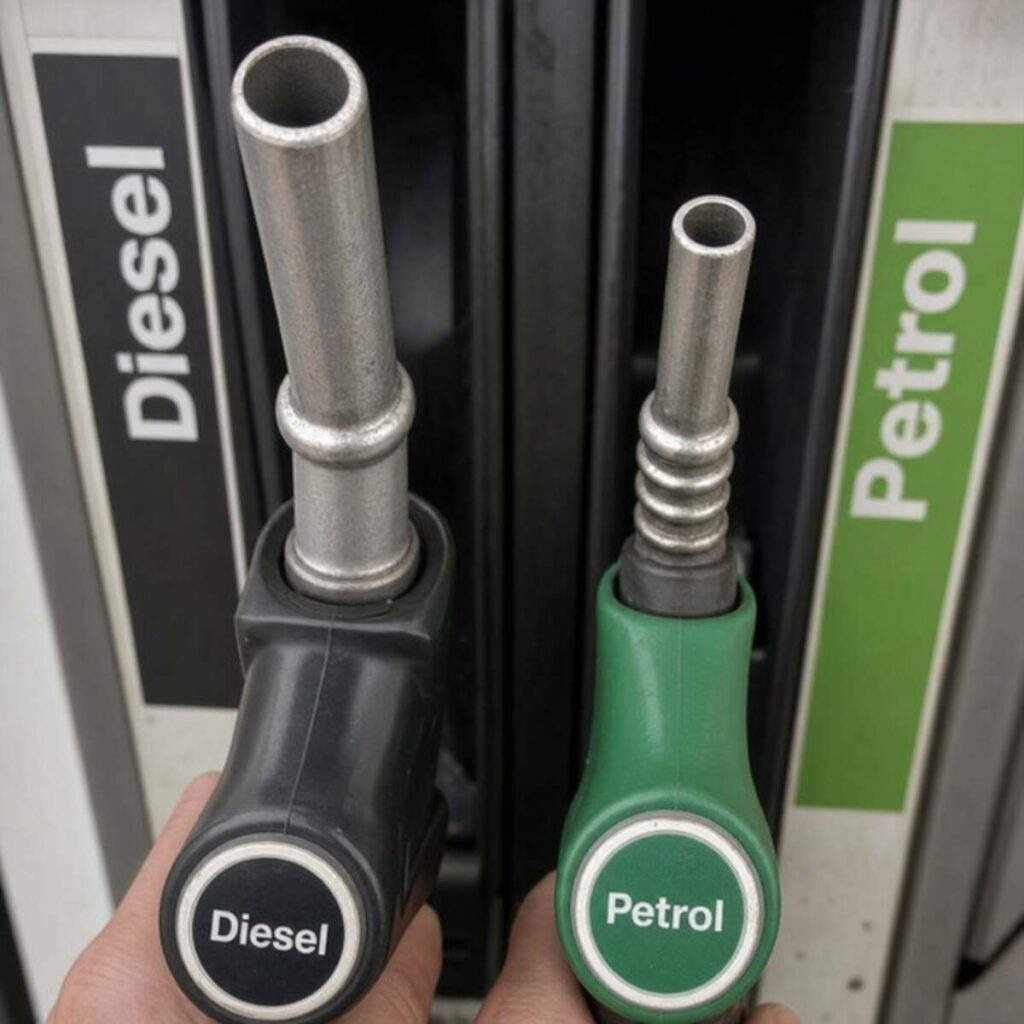
You might be wondering how you managed to make this mistake in the first place. A major contributing factor is the physical design of the pumps, specifically the diesel vs petrol nozzle sizes.
- Diesel Nozzles: These are larger in diameter. They are designed to fit perfectly into the wider filler neck of a diesel vehicle.
- Petrol Nozzles: These are narrower.
Because the petrol nozzle is smaller, it slides effortlessly into the wider filler neck of a diesel car. This is why putting petrol into a diesel car is incredibly common. Conversely, the thick diesel nozzle physically will not fit into the narrow filler neck of a modern petrol car. To put diesel into a petrol car, a driver usually has to force it in, hold the nozzle awkwardly against the filler, or use a jerry can—making it a much rarer occurrence.
Scenario 1: Petrol in a Diesel Engine (The Most Dangerous)
Putting unleaded petrol into a diesel engine is the most common form of fuel contamination and, unfortunately, the most destructive. To understand why, we need to look at how a diesel engine operates compared to a petrol engine.
The Chemistry of the Contamination
Diesel fuel is not just a combustible liquid; it is a heavy, oil-based fluid that acts as a vital lubricant. As diesel travels through the fuel system, it lubricates the high-pressure fuel pump, the intricate fuel lines, and the exceptionally precise fuel injectors.
Petrol, on the other hand, is a highly refined, thin solvent. When you introduce petrol into a diesel system, it immediately strips away the thin layer of lubricating diesel oil.
The Consequences of Unleaded in a Diesel Engine
When a diesel pump operates without lubrication, metal rubs directly against metal at incredibly high speeds and pressures. This creates thousands of microscopic metal shards (swarf). These shards are then pushed through the rest of the fuel system, acting like liquid sandpaper.
If you start the engine, the consequences of unleaded in a diesel engine include:
- Destruction of the high-pressure fuel pump.
- Clogged and ruined fuel injectors.
- Contamination of the entire fuel line system.
- Complete engine failure requiring thousands of dollars in repairs.
High-Pressure Fuel Pump Failure Symptoms
If you did not realize your mistake at the pump and drove away, you will soon experience high-pressure fuel pump failure symptoms. These include:
- A sudden loss of engine power.
- The engine whining, knocking, or making a metallic grinding noise.
- The vehicle going into “limp mode” (a severely restricted speed to protect the engine).
- The engine stalling completely and refusing to restart.
Symptoms of Petrol in Diesel Engine
Even before the pump fails completely, the engine will tell you something is terribly wrong. The most common symptoms of petrol in a diesel engine include:
- Rough Idling: The car will jump and stutter when stationary.
- Excessive Smoke: You may notice unusual, light-colored smoke billowing from the exhaust.
- Engine Knocking: A loud, rhythmic knocking sound caused by petrol detonating prematurely under the high compression of a diesel engine.
- Failure to Start: If you parked the car, the engine may simply refuse to turn over the next time you try to start it.
Scenario 2: Diesel in a Petrol Car
While the physical differences in pump nozzles make this mistake difficult, it still happens—often when transferring fuel from an unmarked jerry can. While less catastrophic than the reverse scenario, it still requires immediate attention.
The Chemistry of the Contamination
Petrol engines use spark plugs to ignite a highly volatile mixture of air and petrol vapor. Diesel fuel is much heavier, thicker, and less volatile. It requires intense pressure to ignite, not just a tiny electrical spark.
Damage from Diesel in a Petrol Car
Because diesel is thick and oily, it clogs the delicate spark plugs and fuel injectors of a petrol engine. The spark plugs simply cannot ignite the thick diesel fuel. The most immediate damage from diesel in a petrol car is that the engine will choke, misfire, and stall.
If you attempt to drive with diesel in a petrol car, you may experience:
- Heavy Misfiring: The engine will jerk and hesitate aggressively.
- Thick Black Smoke: Unburnt diesel fuel will be pushed out through the exhaust system, resulting in plumes of thick, sooty black smoke.
- Engine Stalling: The engine will shut down quickly as the spark plugs become completely fouled by diesel oil.
Catalytic Converter Damage from Incorrect Fuel
The most expensive risk in this scenario involves your vehicle’s emissions system. Your exhaust contains a catalytic converter, a honeycomb-like structure made of precious metals that scrubs harmful emissions from exhaust gases.
If unburnt diesel fuel is pushed out of the engine and into the hot exhaust system, it can coat the inside of the catalytic converter. When this thick fuel eventually heats up and ignites inside the exhaust, it can cause the ceramic honeycomb structure to melt. Catalytic converter damage from incorrect fuel is a serious issue, as replacing this single component can cost upwards of $1,000 to $2,500 depending on the make and model of your vehicle.
How to Safely Drain a Fuel Tank
When you face fuel contamination, the only solution is to completely remove the contaminated mixture from your vehicle. You might be tempted to try to siphon it out yourself with a garden hose to save money. Do not do this.
Modern cars have complex fuel tanks with anti-siphon valves, baffles, and multi-chamber designs. A DIY siphon will only remove a fraction of the fuel, leaving enough contaminated liquid behind to destroy your engine. Furthermore, handling large quantities of highly flammable, mixed fuel without specialized grounding equipment is a massive fire hazard.
Instead, you need to understand how to safely drain a fuel tank using professional methods. This is why calling an emergency fuel recovery specialist is essential.
The Professional Fuel Tank Flushing Procedure
When a mobile fuel drain specialist arrives at your location, they follow strict safety protocols and use specialized, ATEX-approved (explosive atmosphere certified) pumping equipment. Here is a detailed breakdown of the fuel tank flushing procedure:
- Site Safety Assessment: The technician will first secure the area, ensuring there are no naked flames or static electricity risks. They will earth the vehicle to prevent static sparks.
- Accessing the Fuel System: Depending on the vehicle, the specialist will access the fuel tank. This is usually done by disconnecting the main fuel line at the engine bay or removing the rear seat to access the fuel sender unit directly on top of the tank.
- High-Volume Evacuation: The technician hooks up an industrial suction pump to the tank. This safely and rapidly draws out the entire contaminated fuel mixture into a sealed, certified waste tank in the back of their response vehicle.
- The Fuel System Decontamination Process: Once the main tank is empty, the true expertise comes into play. The technician will flush the system. This involves pouring a few liters of the correct fuel into the tank and using the specialized pump to draw it through the fuel lines, effectively rinsing the system of any residual contamination.
- Priming the Engine: Once the fuel system decontamination process is complete, the technician will add enough of the correct fuel to get you moving. They will then bleed the fuel system of any air and prime the engine to ensure it starts smoothly.
- Waste Disposal: The specialist will remove the contaminated fuel. By law, mixed fuels must be disposed of at licensed environmental processing facilities, as they cannot simply be poured down a drain or thrown away.
The Costs Involved: What to Expect
Misfuelling is a mistake that carries a financial penalty, but acting quickly keeps that penalty to a minimum.
Mobile Fuel Drain Service Cost
If you realized your mistake before starting the engine, you are in luck. You only need a basic drain-and-flush.
The cost of a mobile fuel drain service typically ranges from $200 to $400 (or £150 to £250 in the UK, where this service is common). The exact price depends on several factors:
- Your location: Remote areas or busy motorways may incur a higher call-out fee.
- Time of day: Middle-of-the-night emergency call-outs generally cost more than daytime services.
- The vehicle: Vehicles with dual fuel tanks or notoriously difficult-to-access fuel lines may require more labor time.
When you consider that a destroyed diesel high-pressure fuel pump and set of injectors can cost between $3,000 and $8,000 to replace, spending a few hundred dollars on an emergency drain is a small price to pay.
Costs if the Engine Was Started
If you started the engine and drove until the car broke down, the financial picture becomes much grimmer. A simple drain will no longer suffice. The vehicle will likely need to be towed to a mechanical workshop.
The mechanics will have to perform a deep, invasive clean. They will need to remove and manually flush the fuel lines, drain the fuel filter housing and replace the filter, and potentially remove the injectors for ultrasonic cleaning or replacement. If the high-pressure pump has begun to disintegrate, the entire fuel system must be replaced to ensure no microscopic metal shavings remain. Bills for this level of repair easily run into the thousands.
Dealing with Insurance: Are You Covered?
When faced with an unexpected bill, the first question most drivers ask is: Does insurance cover putting the wrong fuel in a car?
The answer is: It depends entirely on your specific policy and your provider.
Car Insurance Misfuelling Cover
Historically, car insurance companies viewed misfuelling as a form of “self-inflicted negligence,” meaning they would outright refuse to pay out for the damages. However, as the problem has become incredibly widespread, many insurers have adapted.
Today, car insurance misfuelling cover is often handled in one of three ways:
- Included in Comprehensive Cover: Some high-tier, fully comprehensive insurance policies now include accidental misfuelling as standard. If covered, they will usually pay for the tank to be drained and flushed, and will pay for the engine repairs if you accidentally drive the vehicle.
- Available as an Optional Add-on: Many insurers offer misfuelling cover as a relatively inexpensive optional extra (similar to adding key cover or legal protection). If you did not explicitly check the box to add this when you took out the policy, you will not be covered.
- Excluded Completely: Budget insurers and basic “third-party, fire, and theft” policies will almost certainly not cover you for fuel contamination.
Important Insurance Caveats to Remember
Even if your policy claims to cover misfuelling, you must read the fine print.
- The Excess: If the cost to drain the tank is $250, but your policy excess (deductible) is $500, there is no point in making a claim. It is cheaper to pay for the mobile fuel drain service out of your own pocket.
- No Claims Bonus: Making a claim for a fuel drain will likely count as an “at-fault” claim, which will negatively impact your no-claims discount and increase your premiums the following year.
- Duty of Care: If you realize you put the wrong fuel in your car but decide to start the engine and “risk it” to drive home, the insurer may reject your claim on the grounds that you failed to mitigate the damage.
Roadside Assistance for Fuel Contamination
Rather than making a claim on your main car insurance, it is often better to use your breakdown cover. Many premium roadside assistance packages (such as AAA in the US and AA/RAC in the UK) include coverage for fuel contamination.
If your breakdown policy covers it, they will either send a specialized fuel drain van to you directly or tow you to a garage for a drain, completely free of charge (aside from the cost of the replacement fuel). Always check your breakdown app or paperwork before calling an independent recovery specialist.
How to Prevent Misfuelling in the Future
Once you have gone through the stress, embarrassment, and expense of a fuel drain, you will likely be paranoid at the pumps for months. Fortunately, there are actionable steps and tools you can use to ensure this never happens to you again.
Stay Present at the Pump
The vast majority of misfuelling incidents occur because the driver is running on autopilot.
- Put the phone away: Do not make phone calls or scroll through social media while refueling.
- Read the pump, not just the color: While green usually means unleaded and black usually means diesel (in Europe), colors can vary by brand and country. Always read the physical label on the pump trigger.
- Double-check unfamiliar cars: If you are driving a rental car, a borrowed car, or a brand-new purchase, double-check the fuel type. You can usually find the fuel type written on the inside of the fuel filler flap or on the dashboard fuel gauge.
Install a Misfuel Prevention Device for Diesel Vehicles
Because putting petrol in a diesel is the most common and damaging mistake, engineers have developed physical safeguards. You can purchase an aftermarket misfuel prevention device for diesel vehicles.
These are replacement fuel caps or inserts that fit directly into the filler neck of your diesel car. They feature a specialized locking mechanism. Because the petrol nozzle is narrower than the diesel nozzle, the locking mechanism will only disengage when a wider diesel nozzle is inserted. If you try to push a narrow petrol nozzle into the device, mechanical flaps physically block the nozzle from entering, making it literally impossible to misfuel.
These devices cost roughly $40 to $60 and can be installed by hand in seconds. For multi-car households or companies with fleet vehicles, they are an incredibly wise investment. Many newer diesel cars from brands like Ford, Land Rover, and BMW now come with these specific misfuel prevention mechanisms built-in at the factory.
What Happens to the Contaminated Fuel?
A common question drivers have while watching their tank being drained is: Where does it all go?
You cannot safely burn a mixture of petrol and diesel in a modern vehicle, and it is highly illegal to dump it into the environment. Emergency fuel recovery specialists transport the tainted mixture to licensed hazardous waste processing plants.
At these plants, the contaminated fuel is sometimes put through complex separation processes to recycle it. More often, the mixed fuel is sold to industrial sectors for used as a heavy heating oil in large industrial furnaces or power plants, where the exact octane/cetane rating is not as critical as it is in a passenger car engine.
Frequently Asked Questions (FAQs)
To ensure you have all the information you need, here are the answers to some of the most frequently asked questions regarding wrong fuel in a car.
Can I just dilute the wrong fuel by filling the rest of the tank with the right fuel?
Absolutely not. This is an old myth. Some people believe that if they put 5 liters of petrol in a 50-liter diesel tank, they can simply top off the remaining 45 liters with diesel to “dilute” it. Modern engines operate at incredibly high tolerances. Even a 5% petrol mixture in a diesel engine will dramatically alter the fuel’s flash point and reduce the required lubricity, leading to irreversible wear on the fuel pump. You must drain it.
How long does a mobile fuel drain take?
If you call a professional roadside assistance specialist, the actual fuel tank flushing procedure usually takes between 30 and 50 minutes from the time they arrive. You will generally be back on the road within an hour.
Will putting the wrong fuel in my car void my warranty?
Yes. Manufacturer warranties cover defects in materials and workmanship. They do not cover user error. If your engine is destroyed because you put petrol in a diesel engine, the dealership will test the fuel, identify the contamination, and void the warranty claim for the fuel-system components. You (or your insurance) will be responsible for the repair bill.
Is it safe to leave the wrong fuel in the tank overnight?
If you realize your mistake, park the car, and plan to call a mechanic the next day, the car is generally safe sitting overnight. The petrol will not magically eat through the metal or plastic of the fuel tank. However, petrol is a solvent, and leaving it sitting in delicate rubber diesel lines for extended periods can cause the rubber seals to degrade. It is best to have it drained as quickly as possible.
I drove the car and it broke down. Is my engine completely ruined?
Not necessarily, but it will require significant mechanical intervention. The engine block itself (the pistons and cylinders) usually survives. The “ruined” parts are specifically the fuel delivery components: the low-pressure pump, high-pressure pump, fuel rails, and injectors. Replacing these is highly expensive, but it generally saves the vehicle from needing a complete engine replacement.
Summary Checklist: Your Emergency Action Plan
If you find yourself reading this article while standing at a petrol station in a panic, follow this brief checklist:
- Hands off the keys. Do not start the ignition. Do not put the key in the accessory position to listen to the radio or roll up the windows.
- Neutral and push. Put the vehicle in neutral and manually push it to a safe parking spot.
- Check your cover. Look at your breakdown cover or car insurance misfuelling cover to see if you can get a free professional drain.
- Call the experts. Search for an “emergency fuel recovery specialist near me” and request a mobile dispatch.
- Wait safely. Relax. While it is an annoying inconvenience, because you didn’t start the engine, your car will be absolutely fine once the fuel tank flushing procedure is completed.
Conclusion
Putting the wrong fuel in a car is a frustrating, palm-sweating experience, but it does not have to spell the end of your vehicle. The severity of the situation rests almost entirely on what you do in the seconds after you realize the mistake.
Understanding the significant chemical differences between petrol and diesel highlights exactly why the fuel system decontamination process is so critical. Diesel acts as a necessary oil, while petrol acts as a stripping solvent. Mixing the two in a modern, highly tuned engine is a recipe for expensive disaster.
By remembering the golden rule—never start the engine—and relying on professional roadside assistance for fuel contamination to safely handle the draining and flushing, you can turn a potential $5,000 engine rebuild into a minor inconvenience. Stay alert at the pumps, consider investing in a misfuel prevention device, and drive safely.
