


Have you ever seen a friendly game of Monopoly end with a flipped board or a round of Uno get a little too competitive? We love game nights, but sometimes the rivalry can overshadow the fun. What if there was a different way to play? A growing category of games offers an exciting alternative by flipping the script entirely. Instead of players battling each other, everyone teams up to challenge the game itself. This shifts the goal from individual victory to group survival. Check out cuan805 to know more
Instead of one person celebrating a win while others grumble, the table fills with shared puzzle-solving and strategic chatter. These family card games, where you work together are designed to create a single, powerful moment: the collective high-five when your team finally cracks the code. It’s that shared “we did it!” experience that transforms game night from a battleground into an exercise in teamwork.
What If the Game Itself Was Your Opponent?
Think about most card games you’ve played, from Poker to Uno. The goal is almost always to beat the other players. Cooperative games flip that on its head. It’s a complete shift from “Player vs. Player” to “Player vs. Game,” where you’re all on the same team.
This might sound strange—how can a deck of cards fight back? It’s usually done in a simple but clever way. After each person takes a turn, the game gets a turn. This often means drawing a card from a “trouble deck” that creates a new challenge, reverses your progress, or adds a ticking clock. This automated opponent ensures the pressure is always on.
As a result, there are no individual winners or losers. Instead, these games have a shared victory condition: either the entire team wins together by achieving the goal, or the game wins, and everyone loses together. The competitive tension is replaced with collaboration, communication, and those fantastic “aha!” moments when your team pulls off a brilliant move. It’s less about individual glory and more about the satisfaction of solving a puzzle together.
Your First Cooperative Challenge: Can You Read Your Team’s Mind?
For a perfect first taste of this team-based puzzle, look no further than a deceptively simple game called The Mind. The goal is straightforward: as a group, you must play cards numbered 1 to 100 into the center of the table in ascending order. The catch? You cannot speak, gesture, or give any clues about what’s in your hand. It’s just you, your teammates, and a shared sense of timing.
This sounds impossible, but it’s where the magic happens. The game forces everyone to get on the same wavelength. If you’re holding a very low card, like a 3, you’ll feel an instinct to play it almost immediately. If you have a high card, like a 92, you’ll naturally pause. The tension builds as you silently count in your head, hoping someone doesn’t play their card just a moment too soon. The game becomes a fascinating exercise in creating a group intuition from scratch.
The Mind is brilliant because it boils teamwork down to its purest form: shared focus and trust. Successfully clearing a round without a mistake feels like a genuine mind-meld. While this silent challenge is a fantastic starting point, many cooperative games use more familiar mechanics.
For Fans of Spades or Hearts: How ‘The Crew’ Turns a Classic into a Team Sport
If the silent, psychic connection of The Mind sounds a bit too abstract, The Crew: The Quest for Planet Nine might be right up your alley. It takes the familiar DNA of classic card games like Spades or Hearts—where everyone plays a card and the highest one wins the “trick”—and flips it on its head. Instead of competing for points, you’re all on the same team, trying to achieve a shared goal.
This is where The Crew introduces its brilliant twist: missions. Before you play a card, the game gives your team specific objectives. For example, one mission might be, “The player with the yellow 4 must be the one to win the round where the green 7 is played.” Suddenly, winning a trick isn’t about personal gain; it’s a calculated move to help a teammate succeed.
These missions transform the game into a fascinating collaborative puzzle. Every card you play matters to the entire team, and you have to think several steps ahead. Pulling it off feels like a perfectly executed team play, full of quiet nods and post-game “I knew you were going to do that!” moments. This leads to one of the most clever tools in a cooperative game’s toolbox: limited information.
What Makes a Great Team-Play Game? The Genius of Limited Information
How do you strategize without simply showing your cards? That question is the secret ingredient in many of the best team-based games. If everyone could just say what they had, one person would likely figure out the “correct” move for everyone, turning their teammates into robots. To prevent this, designers build in a fun and challenging twist: you can’t say everything you want to.
This intentional restriction forces true collaboration. The challenge becomes a puzzle of communication, where you have to figure out how to give the most useful information without breaking the rules. The strategy isn’t just about playing the right card; it’s about sending the right message, creating those thrilling “I know what you mean!” moments.
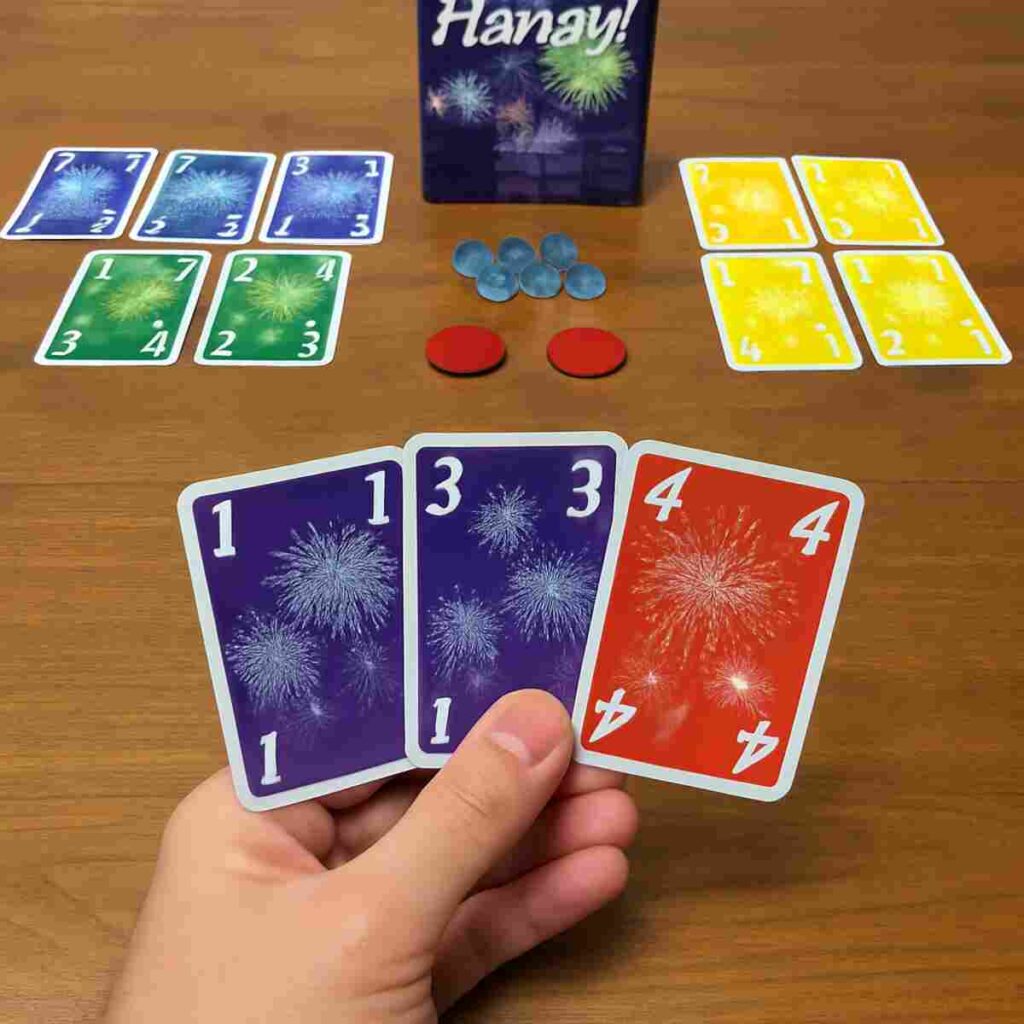
Perhaps no game illustrates this better than Hanabi. In this brilliant little game, you hold your hand of cards facing away from you, so only your teammates can see them. On your turn, you can either give a clue to a teammate about their cards (like, “You have two blue cards”) or try to play a card from your own hand, hoping you’ve pieced together enough clues to play the right one. It’s a game of complete trust and careful memory, perfectly showing how limiting what you can say makes for a much more engaging experience.
How to Be a Great Teammate (And Avoid Being ‘That Person’)
In any team activity, there’s a risk of one person accidentally taking over. In cooperative games, this is sometimes called “quarterbacking,” where one well-meaning player dictates the strategy for the whole group. This can quickly drain the fun out of a game, as the goal isn’t just to win; it’s to win together.
The good news is that it’s easy to encourage a more collaborative spirit. The key is to turn statements into questions and suggestions. Instead of giving orders, try inviting discussion:
- Instead of: “You, play your blue card now.”
- Try: “I think your blue card might be helpful here, what do you think?”
- Instead of: “Don’t do that! Do this.”
- Try: “Hold on, I see a potential problem with that move. Can we talk it through?”
This simple change in how you talk about strategy is the single most effective way to improve your teamwork, ensuring everyone feels involved and valued.
3 Simple Strategies to Help Your Team Win Any Cooperative Game
While every cooperative game is different, a winning strategy often uses the same core ideas. Mastering them will turn your group from hopeful beginners into a well-oiled machine.
First, learn to triage the threat. Most games present you with multiple problems at once. Your team should constantly ask: “What’s the most dangerous thing on the board right now?” Focus all your energy on stopping the one problem that could make you lose the game immediately. Surviving to the next round is more important than making a perfect play.
This survival mindset also changes how you view your turn. The best move isn’t always what helps you, but what perfectly sets up your teammate. This can mean making a small sacrifice—letting a minor problem slide if it means your partner can solve a huge one next. It’s about losing a small battle to win the war, a key skill in any player-vs-board game.
The Best Teamwork Card Games for Just the Two of You
While big group games have their charm, sometimes you just want a great activity for a quiet night in with a partner or friend. Cooperative games truly shine here, transforming the experience into a focused partnership. The teamwork becomes more personal, and the victories feel earned together.
Finding the right game is key, as many are designed for this intimate player count. Here are a few fantastic starting points for 2-player teamwork:
- The Crew: Mission Deep Sea: A brilliant game of solving underwater puzzles with very limited communication.
- Codenames: Duet: A clever, cooperative twist on the popular word-association party game.
- Fox in the Forest Duet: A charming fairy-tale journey where you help each other through the woods.
- Paleo: A slightly more involved adventure about surviving the stone age as a team.
With just two players, the strategies become even more intense. There’s no one else to cover a mistake, so every decision directly impacts your partner’s options. The game becomes a fascinating dance of trade-offs and trust.
Looking for Family Card Games Where Everyone Works Together?
Adding kids to the mix can be a delicate negotiation. Sibling rivalries flare up, and someone often ends up disappointed. This is where cooperative games feel like a parenting superpower. Instead of competing, everyone unites as one team against the game. The goal shifts from one-upping a sibling to figuring out how to help them.
Finding the right game is simple. The box tells you everything: check the age suggestion (e.g., “Ages 8+”) for complexity and the playtime for duration. For families with younger kids, a game under 30 minutes is usually a perfect fit. These beginner-friendly games often have an exciting theme, like escaping a sinking island or saving magical creatures, which gets everyone invested.
A perfect first step is a title called Forbidden Island. Your team must frantically grab four ancient treasures and escape by helicopter before the island sinks beneath the waves. The rules are simple, but the challenge is thrilling. It creates high-fives and “we did it!” moments that competitive games rarely can.
Ready for a Bigger Challenge? Your Next Step in Cooperative Gaming
After you’ve escaped that sinking island a few times, you might crave a new puzzle. The great news is that cooperative games can grow with your group’s confidence, offering deeper strategy and evolving stories that turn a single game night into an ongoing adventure.
One exciting idea is campaign play, where each session is like a new episode in a TV series. Your wins and losses carry over, unlocking new challenges, rules, and story elements. To tackle these bigger threats, games often give you more control. Some of the most engaging team deck building games let you customize your abilities, adding powerful cards to your personal deck during the game. This mechanic makes your character feel uniquely yours and makes many of these games great for solo play too.
A fantastic next step is the modern classic, Pandemic. In this thrilling game, you play as specialists trying to cure four diseases before they overwhelm the globe. It requires more strategic planning than a beginner game, but is still easy to learn. Your best bet for games like this is a dedicated local game store, where the staff can point you toward the perfect challenge for your group.
The Real Victory: More High-Fives, Fewer Flipped Tables
Before, a card game without a single winner might have seemed strange. Now, you have a roadmap to a different world of shared challenges where the real opponent is the game itself. These are games where everyone can win, together.
Your first step has nothing to do with buying a box or reading a rulebook. The next time you gather your friends or family, don’t just ask, “What game should we play?” Instead, try asking, “What kind of memory do we want to create?” This simple shift reframes the goal from individual victory to collective enjoyment.
You’re now ready to find card games that improve teamwork and end with a shared high-five. You will quickly find that the best prize isn’t bragging rights—it’s the collective cheer your group lets out when you solve the puzzle at the very last second.
